I was at a meeting of sailors last night. Tough people, sailing their small ships along the coast or around the world. At dinner I sat next to an elderly gentleman who had sailed round the world, and he told me something about his trip, crossing the Atlantic three times altoghether. Another man sails singlehandedly down to the mediterranean and back, a woman regularly sails up to Sweden.
I'm not really much of a sailor myself, if I'm honest. Yes, I've crossed the Drake Passage more than once, and yes, I've crossed the Atlantic ocean, but I'm still not much of a sailor. I wasn't on such a tiny yacht, but I WAS on a sailing ship, a square rigged bark, a tall ship. I like the ship I work on, she's a beautiful ship, and that she's square rigged is unusual and looks very romantic.
I still don't know much about sailing, though, as I realised again last night. When the captain of my ship started talking about sailing manoeuvres. I sort of know, but I don't really. I know some of the terms, but am never sure what they really mean. I know there's sails involved, and a lot of ropes, and sometimes I pull on ropes, and I know more or less which sail is which, but that's it really.
The evening before my night out with the sailors I was at a Film Festival, the Northern Film Festival, a different kind of atmosphere and a very different group of people, different topics of conversation. Another world, just like the world on board ship is a another world.
Sunday, November 11, 2007


Friday, November 09, 2007
Polar Research

The Scott Polar Research Institute is based in Cambridge, and it is a fascinating place for anyone interested in Antarctic history. One part of the institute is the museum, for me the place to find many mementos of the Scott expeditions. There are cases containing items that belonged to Scott, to Edward Wilson and to other members of their journey to the South Pole. Final letters they wrote, Wilson's drawing materials, Birdie Bowers' copy of the New Testament. Impressive and moving. It makes history come alive, and it is weird to think that some of these items were taken from the tent where Scott and his companions died.


Almost even more impressive is the library in the institute. They seem to have almost every book ever published on Polar science, history, exploration, flora and fauna. It is quite overwhelming. I had a look at some of the books I had heard about, but which I had never seen. I had a good look at the biography of Birdie Bowers. I also looked at some of the volumes of the report on the Discovery expedition. When I opened the volume with photographs on the title page was Edward Wilson's signature! It must have been his own copy.

Visiting this place for the first time is a little overwhelming. There is a whole shelf of books devoted to Tristan da Cunha, something you are not likely to find in many other places. And this includes the books written by Dutch authors. All the books on the explorers seem to be there too. I guess next time I need to take a lot more time than just a day.
Around the time I was at the Scott Institue I also visited that other research institute, the British Antarctic Survey. They are responsible for carrying out research out on the continent these days. A big office building just outside Cambridge, with scientists and support staff. This is modern day science in the Antarctic, no long treks on ships, no two-year expeditions, but modern bases, planes and modern research methods. Most scientists just work on the continent in the Southern summer, you don't necessarily have to winter there anymore. I saw the model for the new Halley station, which looks like something out of a science fiction film, wonderful. Polar research has come a long way in 100 years.
Thursday, November 08, 2007
B.E.
Did I ever mention Bright Eyes are a brilliant band? Listening to Cassadaga again I just couldn't help noticing. Fabchannel.com still has some earlier live shows available on line, which are fascinating. Too bad they didn't record the Amsterdam concert last July.
I'm still not sure what it is I like so much, or what appeals to me so much. It is Conor's voice, the music and the arrangements, and the lyrics. The man seems to have produced so much music in just a few years and there just are some real gems in there. It just seems to work together perfectly.
I'm still not sure what it is I like so much, or what appeals to me so much. It is Conor's voice, the music and the arrangements, and the lyrics. The man seems to have produced so much music in just a few years and there just are some real gems in there. It just seems to work together perfectly.
Tuesday, November 06, 2007
Shackleton

Thinking of early 20th century Antarctic exploration I always think of Scott and Wilson first, I guess I like them for various reasons. Just lately I've been catching up on my Shackleton. I watched the series that was made on his Transantarctic expedition a few years ago. Kenneth Branagh played the title role, and he did that very well. He managed to catch the passion, the compassion and the determination of the man, as well as his charm. I know it was a dramatisation, and in places it didn't look very realistic, but it did give some sense of the human side of the whole expedition.

I also recently watched Scott of the Antarctic, and this series had some of the same features. In some scenes of the film you could clearly recognise Ponting's pictures, in the case of the Shackleton series the images of Hurley came out in some of the shots of the series. They must have been a source of inspiration and information for the makers of the series.
I did feel that much stress was placed on the preparation, and Shackleton's various affairs on land, and the final journey was dealt with relatively quickly. There were few images of the men living on Elephant Island, but I guess spending too much time dealing with that would be a little monotonous maybe. And it all seemed very clean. When the real Shackleton reached the Whaling station at Stromness he wasn't recognised by the Station Master, but the man reaching the Station in the series was easily recognisable as the man who'd started out on this ambitious expedition.
Another funny thing was the role of the Royal Geographic Society. They were asked for funds for the expedition but didn't provide much. When asked to help set up a rescue expedition they weren't very keen either. So I wonder what Shackleton would think of his statue adorning the current quarters of the Society.
When I was on South Georgia I visited Shackleton's grave. A simple grave amongst the whalers, but it does seem the right place for him to be. South Georgia is one of the most beautiful places in the world for me, a perfect last resting place.

Sunday, November 04, 2007
Surprises
When you wander around London you can have some unexpected encounters. Only a few minutes after encountering Dutch royalty wandering round the street, I was suddenly almost face to face with one of the great Antarctic heroes. Well, I would have been if I'd been twice as tall, now I was literally looking up to Ernest Shackleton in full Antarctic gear. Impressive...

I've been reading about Shackleton again, or rather reading about the part of the Trans-Antarctic Expedition that he was not immediately part of. While he was dealing with his own little problems in the Weddell Sea there was another, smaller, party working for him on the other side of the continent, laying depots of food and fuel for his team. They ran into a lot of problems of their own, but still continued their work, not wanting to let the boss down. An amazing story, but unfortunately the outcome wasn't quite as good as that of Shackleton's own party. Not all members of the party on the other side survived.
I've also been watching the adaptation of the story of the main expedition for television, with Kenneth Branagh playing Shackleton. I'm halfway through now, and it's interesting. I'll get back to this one when I've seen all of the series.
Saturday, November 03, 2007
Mechelen

I was in Mechelen to see a concert at the Stadsschouwburg. Maybe not the most obvious place for me to attend a concert, but that is just the way it worked out. What I didn't know was that 1 November is a national holiday in Belgium and that meant that all the shops and museums and many of the restaurants were closed. It was a pretty grey day anyway, so it turned into a slightly depressing day, just wandering round the almost deserted centre of Mechelen.

The thing that did make it all worthwhile in the end was the concert. It was An Pierlé I had come to see, and I have seen her a few times before, or quite a few, but this was a slightly different concert again. After the tour built very much around the new album, "White Velvet" last year, she now played a mix of songs from that album, from earlier albums, and some new songs.
She wore a shiny white dress with lots of sparkles this time, very stylish and very An. The set-up on stage a little different than before, Peter not way in the back with a full set of drums but more to the front. And An had a proper grand piano. And there was a little more room for the cello again.

A few new songs I hadn't heard before, and some old ones I hadn't heard live before either, like "Tower", which is a great song. She also sang "Build a Better Life", and was accompanied by Peter on high chair and ergonomic sitting ball, a new style of percussion that worked well.
The theatre was quite posh, a real old-fashioned theatre, and the audience didn't seem like An's regular audience. The set was relatively quiet, maybe because of that. The hall wasn't very big, which did create an intimate atmosphere, and also made it a slightly different concert.

I spent a short while in the theatre in the afternoon too, when the band was rehearsing. An empty theatre, just the musicians and technicians, testing the light and the sound. A different atmosphere again. Nice to hear some of the songs in such a different setting altogether.

Monday, October 29, 2007
Teaching
Once or twice a year I teach a short course on Dutch urban planning legislation. Not the easiest of subjects generally. A lot of rules and regulations, and it seems to get more complicated every year. Today was my turn to teach again, and I had to present the basic principles in about three hours to a class of 14 people. The people taking part are all in some way involved in urban planning, some know a lot already, and some know next to nothing. Every time I teach this course it is different. Sometimes I have just four or five people and I get into detailed discussions on various specific aspects, that people have come across in the course of their work and about which they already know a lot.
Today I had a big group consisting mainly of people who are just starting out, and I spent most of the morning explaining the basics, several times. The questions kept coming from all over the place, and they were not always the kind of questions you might expect. By the end I was completely worn out.....
Today I had a big group consisting mainly of people who are just starting out, and I spent most of the morning explaining the basics, several times. The questions kept coming from all over the place, and they were not always the kind of questions you might expect. By the end I was completely worn out.....
Sunday, October 28, 2007
Sunday and Small Corners
Some Sundays you just don't get round to doing much of anything. You write some emails, you tidy up all the stuff that has been collecting in different places in your room over the week, you listen to the radio. Jeremy Hardy was comedy controller on BBC7 today, and he played the Hancock episode about Hancock and his companions being bored stiff on a Sunday afternoon. There is some great comedy around. I very much like Jeremy Hardy anyway, and I like his choice of comedy. And Hancock did make some great programs, not without the help of Galton and Simpson, of course. But I digress.
In the end I went for a long walk to the other side of town, to Diemen, because that was where I had to be this evening. The weather was lovely, slightly chilly autumn weather. Along the way I took pictures of houses I really like, details of statues. I would normally be on a bike covering this distance, but walking all the way you see so much more. A tiny park next to a bridge with a row of statues of children, details in the architecture of certain buildings, a tree growing almost into a house. This isn't the centre of town, the part usually visted by tourists, but just outside. A good place for experimenting with a new camera. There is some very nice variety in architecture, and often when I cycle here I look at these houses. Not bad at all.
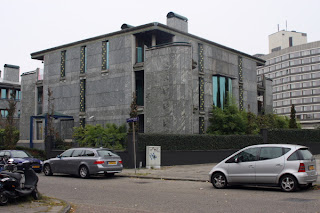
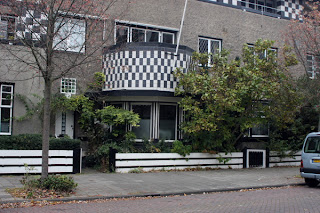
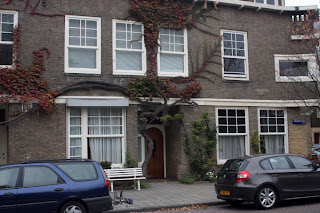
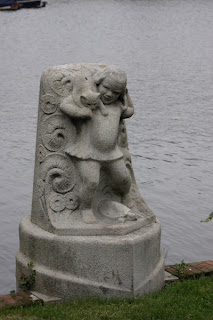

In the end I went for a long walk to the other side of town, to Diemen, because that was where I had to be this evening. The weather was lovely, slightly chilly autumn weather. Along the way I took pictures of houses I really like, details of statues. I would normally be on a bike covering this distance, but walking all the way you see so much more. A tiny park next to a bridge with a row of statues of children, details in the architecture of certain buildings, a tree growing almost into a house. This isn't the centre of town, the part usually visted by tourists, but just outside. A good place for experimenting with a new camera. There is some very nice variety in architecture, and often when I cycle here I look at these houses. Not bad at all.


Saturday, October 27, 2007
Alan Coren
Long ago, in a previous life, I was a great fan of the News Quiz. I could listen to various episodes over and over again. This was the time of Richard Ingrams, Alan Coren and Ian Hislop. I loved the Way Alan Coren could just take off and tell one his wonderful stories. He had a great sense of humour, and I would laugh out loud regularly. I've rediscovered the programme, some new players, still a great many laughs, but no Alan Coren.
Last week Alan Coren died, and his News Quiz colleagues paid tribute to him this weekend. A lot of Coren stories could be heard again, and it made me realize just how funny he could be, and just how unique his way of telling a story was. He just seemed to be taking off without going anywhere in particular, but at the same time he always seemed to end up exactly where he wanted to be. And it still had me laugh out loud. So he will be missed by me too.
Last week Alan Coren died, and his News Quiz colleagues paid tribute to him this weekend. A lot of Coren stories could be heard again, and it made me realize just how funny he could be, and just how unique his way of telling a story was. He just seemed to be taking off without going anywhere in particular, but at the same time he always seemed to end up exactly where he wanted to be. And it still had me laugh out loud. So he will be missed by me too.
Monday, October 22, 2007
A Chill in the Air
Well, this morning it was time for gloves and a scarf again. They say temperatures went below zero last night. And the maximum for today should be about seven. So I guess we're heading for winter again...
Sunday, October 21, 2007
Luka in Paradise
Well, I went to see Luka again, this time in Paradiso in Amsterdam. Known locally as the temple of pop. It was once a church, and that is still very obvious when you're inside. The stage set as always, guitars, flowers, Luka seated again. The first half of the concert he used the Spanish guitar, the second half it was Rudy's turn.
He played a lot of new songs, some written about a year ago, some written during his recent German tour. And he sang a lot of old favourites, some unexpectedly. The second song of the evening was one of my favourites, about the uprising in Tibet, called "As I Waved Goodbye". I first heard this song shortly after it was written, when I first saw Luka in concert in Utrecht. At the time he still had the sruti box for accompaniment, which made it special. Then came the version on the album "Between the Mountain and the Moon", and now the accompaniment is on the guitar. He played a lively version yesterday, which I liked very much. And a beautiful "City of Chicago", a hard subject to sing about but it just is such a beautiful song. And good to know that both Christy and Luka sing that one.
He played a lot of old favourites. I was happy to hear "Exploring the Blue", still one of the most beautiful songs he's written. Two surprises were "Chiara" and "The Fertile Rock". He mentioned not having done "The Fertile Rock" for a while, which I knew, so I was surprised to hear him play that one. And "Chiara" is an old favourite, for the name, for the story behind it, for the lyrics and the passion.
He also did the songs that will always make me happy, the ones that make it hard for you to stay in your seat. One is "You Couldn't Have Come at at Better Time", the other one "Perfect Groove". He ended this one the way he ended the concert earlier in the year in the Amstelkerk with "Wave Up to the Shore", no accompaniment and no amplification. A lovely way to end a concert in a, former, church.
For every favourite I heard there was one missing, but that is simply because there are so many songs that I love. I can understand why there was no "Delirious", I would have loved to hear "Black is the Colour". The elusive one for me is "Don't Be Afraid of the Light That Shines Within You", but that one I certainly didn't really expect. It was good to see him again.
Saturday, October 20, 2007
The London Stage

Alex Jennings is appearing at the National Theatre at the moment, playing the lead in "Present Laughter", Garry Essendine. He is brilliant, of course. The play was written by Noel Coward and is a sophisticated comedy. The reviews are mixed, about the play, but the critics agree with my opinion of Alex's performance. His timing is perfect, he's very funny and great for the part. He worked very well with Sarah Woodward, playing Monica, his secretary. Her dry, understated comments worked very well.

I went to see hello to Alex after the performance, but my timing wasn't quite right. Falling down the stairs meant that Alex had hurt his foot and had to limp to his taxi. I didn't want to take up any of his time, but he came over to talk to me, and he was very nice.

Thursday, October 18, 2007
Wilson in Cambridge

Edward Wilson was a student in Cambridge in the 1890s, he was at Gonville and Caius college. So when I went to Cambridge I had to go and see where he lived. The entrance to the college isn't as obvious as that to some of the others, and that says a little about the college. It seems a little smaller, and certainly more intimate... I liked the atmosphere in the courts very much, the intimacy and the trees and the flowers.
I knew Wilson had a room over the gate, I just couldn't remember which gate. or rather I didn't really know there was more than one. When I went to ask at the Porter's Lodge they couldn't really help me, but one of the porters said he would try to find out while I wandered round the college. I walked through the second gate to visit the chapel. That turned out to be small and intimate as well. Knowing about his strong faith I am convinced that Wilson must have spent much time here as well.

Walking back from the chapel I could see the porter coming towards me. He'd been checking his history of the college for Edward Wilson and had found his name, but not which room he'd been in. As I was on my way to the Scott Polar Research Institute I promised to check out where the rooms were. I did, and found the reference in Wilson's biography "Cheltenham in Antarctica".
Later in the afternoon I went back to the college to talk to the porter again, and as I walked into the porter's lodge he was very happy to tell me he'd found out exactly which rooms were Wilson's by talking to the man who wrote a book on the history of Caius, professor Christopher Brooke! We had come up with the same information! Wilson lived over the Gate of Virtue, right in the centre of the college, next to the Chapel.

Wilson made a drawing of the Gate from the other side:

Then the porter really surprised me by asking me if I wanted to have a look at the rooms.... He got on the phone to the present occupant, and she agreed to let me see the rooms. So I went up there, along a very old spiralling staircase, and was admitted to the rooms. There is an inscription over the fireplace, stating that Edward Wilson lived there from 1892 to 1895. The fellow who now lives there also let me climb up to the roof to enjoy the view from the top of the gate. A very lovely private balcony. I had only expected to be able to see the rooms from the outside, and to be given the chance to have a proper look at them was very special. I am very grateful to the friendly people at Gonville and Caius College.
I didn't have my camera with me, so I couldn't take a picture, but I did find this one of the room at the time when Wilson lived here:

Wednesday, October 17, 2007
Falling in Love

I sort of fell in love with Cambridge when I was there. It is a beautiful city, with a lot of different environments. The areas around the centre have their terraced houses, the centre has its shopping streets and colleges, and there are tourists and students everywhere.

One of the things that really struck me were the bicycles everywhere. Almost as many as we have here, but mainly of a different kind. More helmets, nowhere to place your bag. And they really are all over the place. Cyclists in Amsterdam may create chaos, it's a different kind of chaos in Cambridge. Here cyclists have their own lanes, and very few use pavements or footpaths, but that is different in Cambridge, bicycles are everywhere. At some point I felt the way some tourists must feel in Amsterdam, you feel like you're always in the way of a cyclist. And they come from the wrong side too...

It's the colleges that provide a kind of peace and quiet within the city. The green, wide open space at King's COllege, the intimacy at Gonville and Caius, the silence within Magdalen early in the morning. Most of the colleges have their own chapel, really good places for a little peace. I ended up attending evensong at the King's College Chapel, beautifully sung and very restful.

There are a lot of interesting small restaurants as well, and you don't end up going to all the usual places. Some are to a great extent aimed at tourists, but it doesn't really feel that way. Not a bad place for a vegetarian.

And then there is the range of museums. Art at the huge Fitzwilliam, fossils at the Sedgwick, Polar history at the Scott Polar Research Institute, and there were a lot more I simply didn't have time for. This is the kind of city where three days isn't really enough and you wish you had a lot more time to take things in. I guess I have a few reasons for going back.
Monday, October 15, 2007
Seabirds?
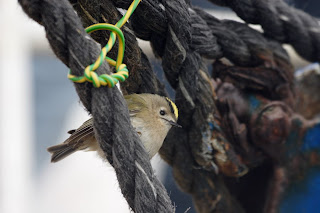
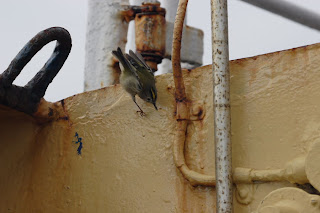
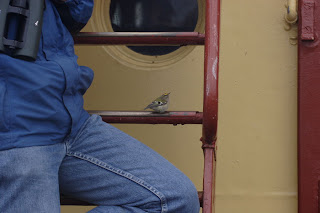
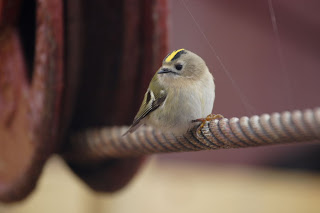
I was out on a boat to see the seabirds. I've had to revise the definition of seabirds though, as the ship was visited by a lot of tiny seabirds. I had one climbing up my trousers, and one landing on my wrist just as I had my arm close to my face to take a picture of other birds just a little further away. My telelens wasn't much use really for much of the time. Though I did get a few nice pictures. Of the Goldcrests...


Thursday, September 27, 2007
Painters
The painters have invaded my house. They are painting the outside, the windows and the front door, but they have decided to try and do as much as they can from the inside. That might have something to do with the wind and the rain. The experienced painter, Philip, the one in charge generally works on the inside while his helpmate, a Scotsman called Brian, is stuck on the scaffolding outside for much of the time.
Brian is nice but not very experienced, and so far he has managed to break a window and to sand the inside of one of the windows instead of the outside, much to the annoyance of Philip, who ends up with a lot of extra work. Philip likes to chat. He talks about his travels, to Southeast Asia and to Mount Everest, and about social politics. He's very charming, and he knows it. He doesn't mind starting a little flirtation late in the afternoon, and he does it very well. It did make me smile.
Today they finished the windows, or as much as they could, the final layer. That meant the windows had to be open all day. I was at work in the living room, with the windows open, and 15 C outside. It definitely isn't summer anymore. Well, they're nearly finished now, so we'll be alright for another winter, and I'll have some peace and quiet again next week. And I'll have warm feet...
Monday, September 24, 2007
First Days of Autumn
It's autumn now. This morning I needed the light on my bike on again cycling into work for the first time. Soon I will be cycling to work and back in the dark again. I don't mind so much, I like this time of change, I like the feeling of just a little chill in the air, though I will miss the warmth and the sunshine. Then again, this wasn't exactly a very warm summer.
Sunday, September 23, 2007
Chernobyl Reclaimed
I went to see a film called "Chernobyl Reclaimed", about the life around Chernobyl after the disaster. The animals have reclaimed the area immediately surrounding the Reactor. They are free to roam the area without humans to interfere with them so on the surface this must be a paradise for them. But all the animals living in the area are radio-active, the bears and the wolves, the feral cats, and the birds. The people filming had to wear protective clothing and they could stay in the area only for short periods at a time, these animals live there and get their food there. They move in and out of the area freely and they seem to be doing very well. It's a worrying thought though.
Monday, September 10, 2007
Bicycles in Amsterdam
An American visitor to Amsterdam spent about an hour a year ago taking pictures of Dutch cyclists, all in one spot in the very centre of Amsterdam. They make a nice illustration of traditional transportation in the city. And it's interesting for me to see all that through the eyes of someone not used to it all. But this is just the way it is...
Amsterdam Bicycles
Amsterdam Bicycles
Friday, September 07, 2007
The Crossing
Living here in the big city, where it is so grey and crowded at the moment, it is hard to imagine that I once crossed the Southern Ocean, sailing all the way from South America to South Africa. People wonder if it isn't boring, spending all that time out at sea with very few landings to break the monotony. Day after day looking
out over a vast ocean, stuck on a small ship with a small group of people.
It's not boring being out there. You always have the world outside the ship to keep an eye on for a start. Sailing from Antarctica via South Georgia to Tristan da Cunha means you get to move from one bird population to another. You start out with the Antarctic birds, the Black-browed Albatrosses, the Penguins, and then you move on to South Georgia, where you get more Wandering Albatrosses and the King Penguins. And then further out on to the ocean you get more kinds of Albatrosses, the Yellow-nosed and the Shy, and more kinds of Petrels and Shearwaters. The Great Shearwaters are such beautiful birds, and this is the only place where you will get to see the Spectacled Petrel. And the landscapes as well as the seascapes are stunning.
Getting closer to South Africa you get to see fewer birds, and you actually get to see some ships. Some are fishing boats that attract all the birds. One of the first big ships we passed got in touch with us on the radio, and it turned out a former Europa crew member was on board. I'd been wearing his waterproof gear for the previous seven weeks.
Travelling all this way also means very slowly travelling from one climate to another, just as you move slowly from one bird population to the next. You start out at the Antarctic Peninsula at the onset of autumn. There are storms, the first snow starts to fall and it is cold and wet. You can't do all the landings you might have wished to do, and you can get a little chilly at times, to put it mildly. Moving towards your first stop it only gets a little warmer. Or we were lucky, when we landed at Grytviken on South Georgia we actually got sunshine, and a lovely walk over to Maiviken. The rest of the trip is a very gradual move from the cold Antarctic to the very warm South Africa. When you plan the trip you think mainly of being on the ship and of being down south, so you have a lot of warm clothes with you. And then you end up in the heat of Africa, going on a short bird safari.
What also keeps you from getting bored is the world inside the ship. Guest and regular crew together build up a routine, that people will quite easily get used to. It's all pretty straightforward. There are the watches to keep you occupied, you can be at the helm, help with all the sailhandling, or take on duties in the galley. The list of jobs to do is endless. When the weather gets a little warmer there is a lot of maintenance work that can be done, fixing things, painting the ship. You get used to getting up in the middle of the night to be up on deck somewhere doing something important. In the dark you get to see the most beautiful skies, because it still is really dark out there. On clear nights you can see all of the Southern sky, you can get beautiful views of the Milky Way. You can also see all the luminescent life beside the ship that migrates up to the surface at night. Little lights above and below you.
Living with a small group of people for several weeks is a very special experience. You get to know people quite well and this is a society you have to be part of for the duration, there is no escape. You are stuck together for seven weeks. There are some people you get to like and you get to spend a lot of time with, and there are people you try not to get too close to if you can help it. And people may move from one category to the next between the start and the end of the trip. A lot happens during that period, and you could write a book just on all that. Reaching Capetown is something of a shock after all that, almost from one moment to the next you move from this tiny, secluded world into all the life and colour of a big city.
Travelling aboard a three mast bark can feel a little like travelling back in time. You cannot hurry, you depend to a great extent on the wind to take you where you want to go. When you are not on watch, when there are no birds, there is time to read. I read all of Dan Brown and all of Jane Austen during this trip, a great way to unwind.
So, if you ever get the chance, take it. The landscape on south Georgia is stunning, Antarctica is a unique place, and Tristan da Cunha is the remotest inhabited island in the world and and well worth a visit. And travelling on a ship is the kind of experience you don't get anywhere else.
Subscribe to:
Posts (Atom)